Stop Rebuilding Your Authorization Process Every Time Something Goes Wrong
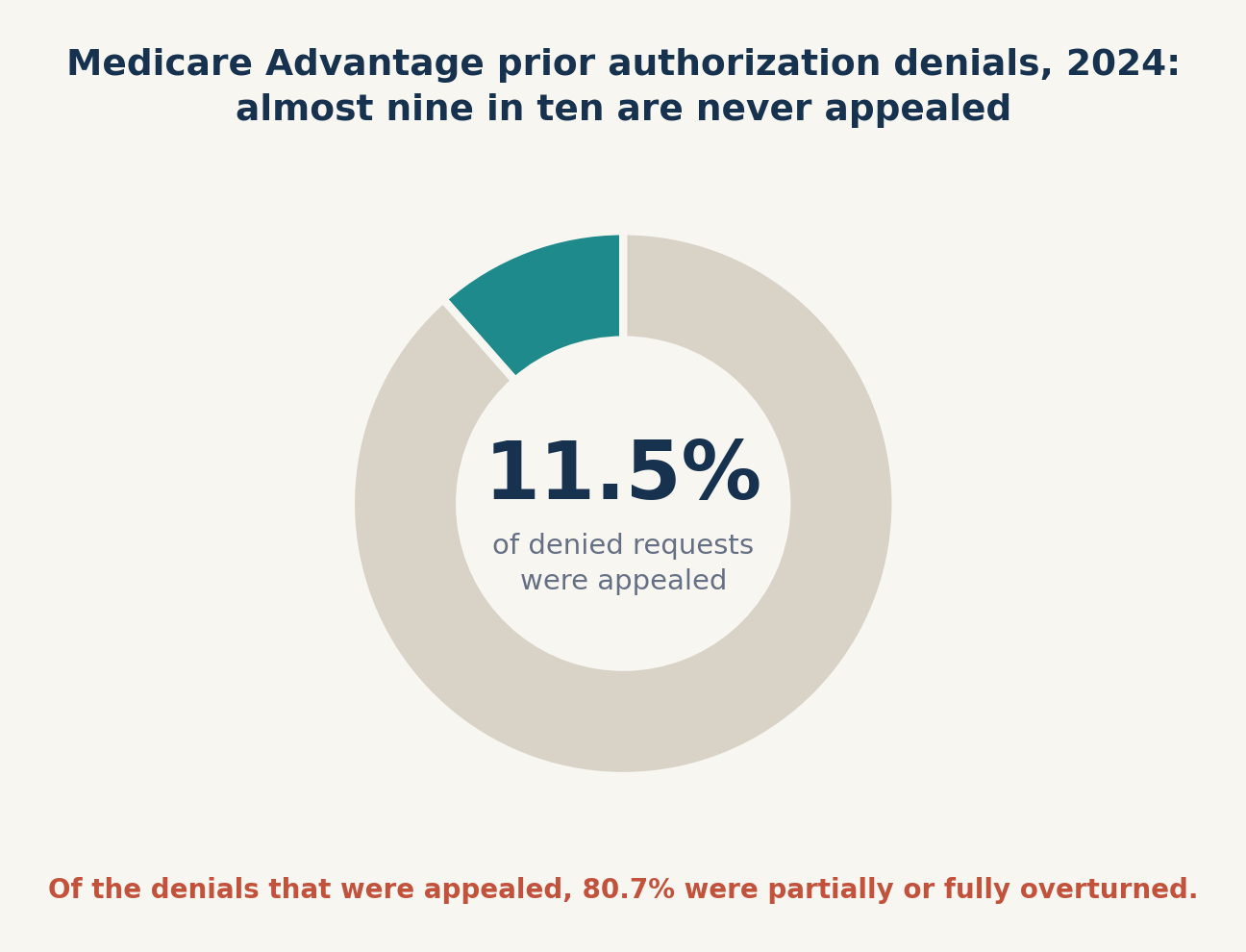
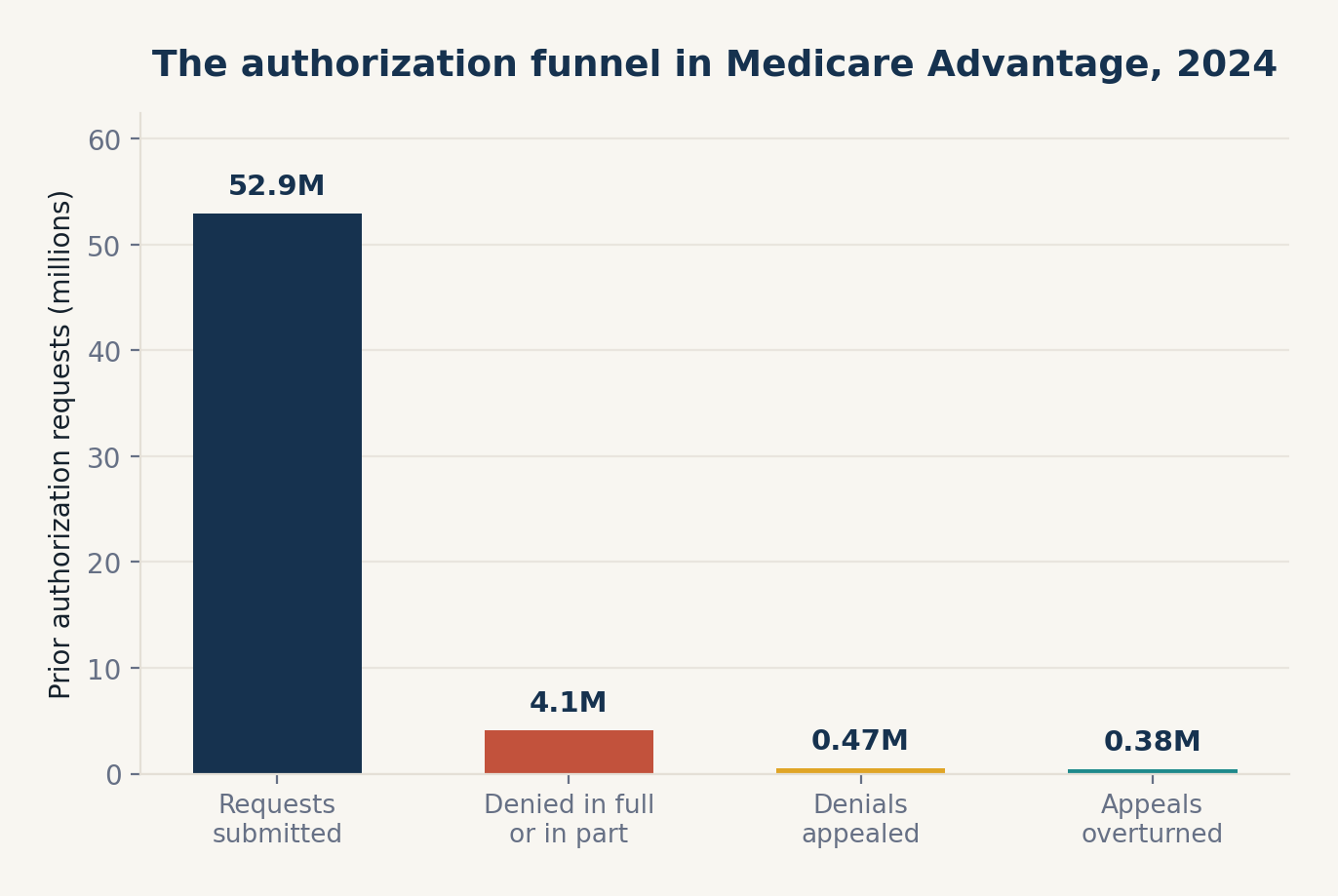
KFF, “Medicare Advantage Insurers Made Nearly 53 Million Prior Authorization Determinations in 2024,” January 2026
The Prior-Auth SOP Pack is a complete operations toolkit for U.S. practices with 1–20 providers: a 113-page guide containing five standard operating procedures, a nine-scenario decision system, twelve letter and appeal templates, eleven payer call scripts, five QA checklists, a payer requirement matrix, an authorization tracker, a management dashboard, an eight-module training curriculum and eight worked case studies.
Ask any experienced biller to explain prior authorization and you'll get a clear answer. Ask the same biller to write down, step by step, exactly what your office does when a procedure changes on the table — and you'll usually get a pause.
Not because they don't know. Because what they do depends on which payer it is, who's at the desk, how busy the week is, and what worked the last time somebody tried. That is the definition of a custom problem: a situation whose solution gets reinvented at the moment it occurs.
Figures cited from KFF, “Medicare Advantage Insurers Made Nearly 53 Million Prior Authorization Determinations in 2024,” January 2026. They describe Medicare Advantage only and do not describe commercial, Medicaid managed care or self-funded plans. Verify current published figures before relying on them.
Every authorization event in your practice routes to a named procedure with a named owner — so the question stops being “what do we do now?” and becomes “which SOP is this?”
Nine scenarios from routine authorization through intra-operative coding change to a payer that says retro-auth doesn't exist — each mapped through trigger, immediate action, owner, documentation, payer contact, submission, follow-up, escalation, appeal and closeout.
A sixteen-step SOP for the service that couldn't wait: how to establish urgency, document why normal authorization wasn't possible, find the right payer channel, capture the reference number, and reconcile the claim before it goes out.
The differentiator. A nine-stage workflow that inserts the missing moment most practices don't have: a field-by-field comparison of the authorization against the final code set, before the claim is submitted.
Six retro-auth request letters, a coding-change appeal, a printable payer communication log, a root-cause review form, a comparison worksheet, a customization worksheet and an implementation scorecard — with placeholders, not descriptions of templates.
From “no authorization obtained” to “payer cannot locate the authorization” to “retro-auth rejected” — each with diagnosis, immediate action, documentation review, payer verification, corrective action, appeal, escalation and resolution.
A 27-field tracker, a 23-column payer matrix, a thirteen-panel dashboard, eight KPIs and a thirteen-category root-cause system — so repeated denials stop feeling like bad luck and start looking like a pattern you can fix.
And all five end at the same place: document, track, close out, root-cause review.
Every payer-specific field in this pack is a blank with a verification stamp rather than a printed answer — because a toolkit that told you “the rule” would be wrong somewhere on the day it shipped.
A seven-question form the case owner completes at closeout, mapping every denial to one of thirteen causes and one change that stops the next one.
Five levels with owner, document, typical window and the specific condition that justifies moving up — plus the reasons that don't.
Eighteen fields on one page, fillable in ninety seconds during the call, including the three fields staff most often skip.
The nine-row field-by-field check between the authorization and the final code set that most practices have no step for.
Twenty-two terms in plain language, with a standing note that payers do not use every term identically.
An end-of-training assessment with a full answer key, so competency is demonstrated rather than assumed.
Eleven checks that tell you honestly whether the system is deployed at day 30 or whether you own a document.
The exact shared-drive layout, so the person who needs the escalation script at 4pm on a Thursday finds it in ten seconds.
This product is newly released. Rather than publish invented reviews, we've left this space for the first real ones.
Awaiting first reader review.
No, and no honest product could. Retro-authorization availability varies by payer, plan, product, contract and state, and it changes. What this pack gives you is the process for establishing the answer quickly, recording it with evidence, and acting inside whatever window applies — plus a payer matrix built to hold that answer for next time.
None of the three. It is an operational and administrative toolkit. Code selection and modifier application belong to appropriately qualified coding professionals working from the documented record. Questions about patient liability, contract terms or state requirements belong to qualified legal or contracting advice. And no letter, script or workflow in this pack guarantees an approval, an overturn, or a dollar.
It's a nine-stage process for the case where the procedure authorized isn't the procedure ultimately performed and documented. Its central move is inserting one missing moment: a field-by-field comparison of the authorization against the final code set before the claim is submitted, with a defined payer call if they don't match. The governing rule, stated first and returned to at the end, is that the code follows the operative record — never the other way round.
Often more so. The handoffs between a practice and an outsourced RCM partner are exactly where authorization cases stall — the practice assumes the partner is working it, the partner is waiting on documentation. The tracker, the single-owner rule and the escalation matrix are designed to make that boundary explicit. Share the customization worksheet with your partner and agree who owns which stations.
No. The tracker, the payer matrix and the dashboard are spreadsheet structures — field lists, status categories and formulas you can build in Excel or Google Sheets in about an hour. If your practice management system has an authorization module, build them there instead; the field lists are what matters, not the tool.
It's designed for roughly 1–20 providers. In a very small practice one person will hold several of the roles, which is fine — the point of the responsibility matrix is that every role is named, not that every role is a different person.
A single zip containing the 113-page guide as a PDF and as a DOCX. Every template, checklist, script, worksheet and tracker field list is inside the guide, formatted to copy into your own documents or print directly. The DOCX exists specifically so you can lift the letter templates without retyping them.
You're covered by a 7-day money-back guarantee. If it isn't a fit, email sales@viralbydesign.co within 7 days of purchase for a full refund.
If the system isn't the right fit for your practice, request a full refund within 7 days of purchase — no complicated process, no hard feelings.
The Prior-Auth SOP Pack is an operational and administrative toolkit. It is not legal advice, not medical advice, not coding certification or coding advice, and not a guarantee of authorization or payment.
Prior authorization requirements vary by federal programme, state, payer, plan or product, contract, facility and procedure, and they change — including mid-plan-year. An authorization does not guarantee payment. Coding decisions must be made by appropriately qualified coding professionals working from the documented record. Clinical documentation must accurately reflect what actually occurred, and no staff member should ever alter documentation or coding in order to obtain an authorization or a payment. Adapt this toolkit to your own contracts, payer policies, state requirements and internal compliance policies before use, and verify current payer-specific requirements before acting.
All case studies, practices, providers, dollar figures and outcomes in the guide are fictional and clearly labelled as illustrations. The statistics quoted on this page are cited from KFF, “Medicare Advantage Insurers Made Nearly 53 Million Prior Authorization Determinations in 2024,” January 2026, and describe Medicare Advantage only. Verify the current published figures before relying on them.
113 pages. Five SOPs. Nine scenarios. Twelve templates. Eleven scripts. Five checklists. Two spreadsheet structures. Eight training modules. One payment, instant access.
Get Instant Access — $12.99